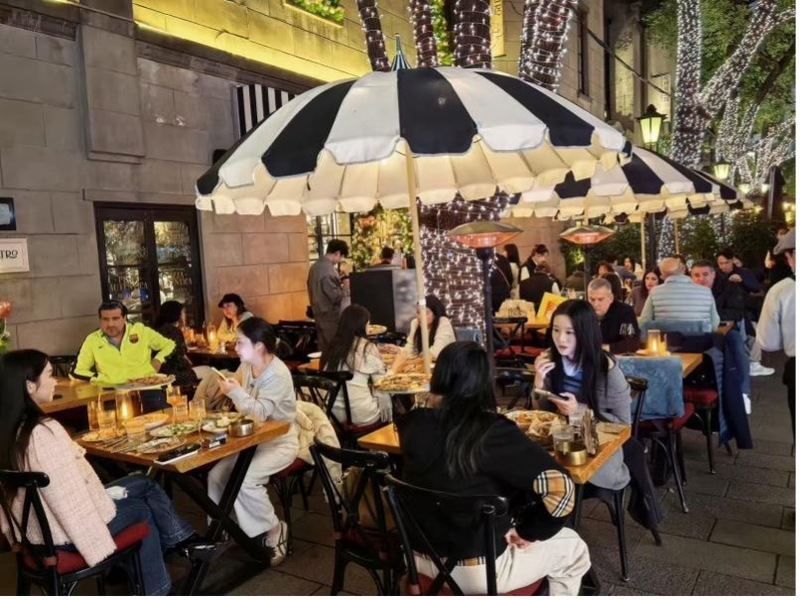
Shanghai’s “Time-Based Outdoor Dining” Initiative: Balancing Urban Vitality and Order
Background and Challenge
Shanghai, as a global metropolis, faces the challenge of balancing commercial vibrancy with urban management. Outdoor dining (外摆位) has historical roots in Shanghai, but strict regulations on street vending and outdoor commercial activity, including bans on extending business operations beyond shop premises, had long constrained business vitality. In December 2022, Shanghai amended its Municipal Appearance and Environmental Sanitation Regulations. With respect to outdoor dining, the Regulations changed the relevant wording from “prohibited” to“prohibited without authorization,” which opened new possibilities for regulated outdoor dining. Since then, Shanghai has been continuously refining policies and service ecosystems, exploring efficient governance models to boost outdoor dining and the nighttime economy. In accordance with the municipal framework, district governments have updated their policies in this area to better manage and facilitate the orderly development of street vending and outdoor dining. Huangpu district, for example, issued version 2.0 of its outdoor dining policy in February 2026, expanding eligible locations for outdoor seating and permits extended operating hours for participating businesses, including bars and cafes. This policy development signals an acceleration in the development of Shanghai’s outdoor dining and nighttime economy.
Policy Timeline
The revised Shanghai Municipal Appearance and Environmental Sanitation Regulations took effect on December 1, 2022, providing the legal foundation for subsequent reforms to allow greater flexibility for outdoor dining. Building on this, the Guidelines on Further Regulating Street Vending Activities (Trial), published on July 5, 2023, specifies that landmark nightlife areas, cultural districts, commercial circles, and scenic spots may permit time-based outdoor dining accounting for festivals and seasonal changes. Measures on Further Supporting the Development of Popular Nighttime Economy Landmarks were then jointly published on August 21, 2025 by the Shanghai Commission of Commerce and seven other Shanghai municipal authorities. The Measures support outdoor dining in areas of local landmarks during nighttime and aim to develop unique scenes of “outdoor dining economy.” In February 2026, the Huangpu District of Shanghai released two revised policy guidelines for street vending activities and outdoor dining. The two guidelines aim to create “outdoor dining–friendly neighborhoods” that attract both residents and tourists for leisure and consumption.
Innovative Approach
Daxue Road of the city’s Yangpu District demonstrates a robust and innovative approach to outdoor dining management. The Road’s management authority led the establishment of an independent committee in 2019 that brings together the government, universities, enterprises, and local residents to jointly contribute to outdoor dining management in the neighbourhood. Since 2023, management standards have been developed and upgraded to version 2.0, adopting a “one road, one plan; one store, one standard” approach. These standards specify permitted zones and areas, unify facility materials, styles, and colors, and establish transparent approval processes with property and multi-department assessments. Accountability is enforced through formal self-governance guidelines: violations can result in loss of outdoor seating privileges, and serious or repeated infractions may lead to non-renewal of business leases. The 700-meter street now hosts nearly 80 specialty merchants, with outdoor seating increasing some businesses' revenue by approximately 30%. To address weather concerns, transparent wind shields were added in winter 2024, boosting sales by 24% from December to March, with February recording nearly 40% growth.
The Measures issued in August 2025 facilitate the setup of outdoor seating at popular nighttime landmarks in Shanghai, add temporary outdoor seats for major festivals and simplify approval procedures for nighttime events. It also adds temporary nighttime parking spaces and pick-up points and promote time-based free parking areas. It encourages nighttime tourist bus routes that connect landmark buildings and nighttime economy sites, upgrades regional nighttime landscape lighting with 24-hour window displays lighting to create a unique commercial atmosphere.
Additionally, the two latest policy documents released by Huangpu District in 2026 relax regulations on outdoor dining, including expanding eligible locations (such as permitting it in certain historical areas), extending operating hours for businesses with outdoor seating, and streamlining application procedures for individual businesses to establish outdoor seating areas.
Outcomes
According to the 2025 China Urban Nighttime Economy Index released by CBN and Rising Lab, Shanghai ranked first nationally with 4.03 million active nighttime outings in 2024. Since June 2025, nighttime consumption reached 88.09 billion yuan, up 3.3% year-on-year. In late July 2025, Shanghai designated its first batch of five “Nighttime Economy Popular Landmarks” and five “Nightlife Destinations.”
Authors:
Yacheng Sun is Professor of Marketing, School of Economics and Management, Tsinghua University.
Maggie Wenjing Liu is Associate Professor of Marketing, School of Economics and Management, Tsinghua University.
Lesley Luyang Song is Associate Professor of Marketing, School of Management,Huazhong University of Science and Technology.